
by Red Rat in Hat

Calculate the racing line, speed, and lap time for your track.

Import a track image, plan, sketch, or satellite view and calculate the racing line, speed profile, braking points, acceleration, and lap time directly on your device. Compare point, car, and motorcycle models to see how the trajectory and calculated performance change.

Racing calculator Track image workflow Karting Lap time Braking points Local calculation

Screenshots

Home screen - RaceLineCalc
Home screen
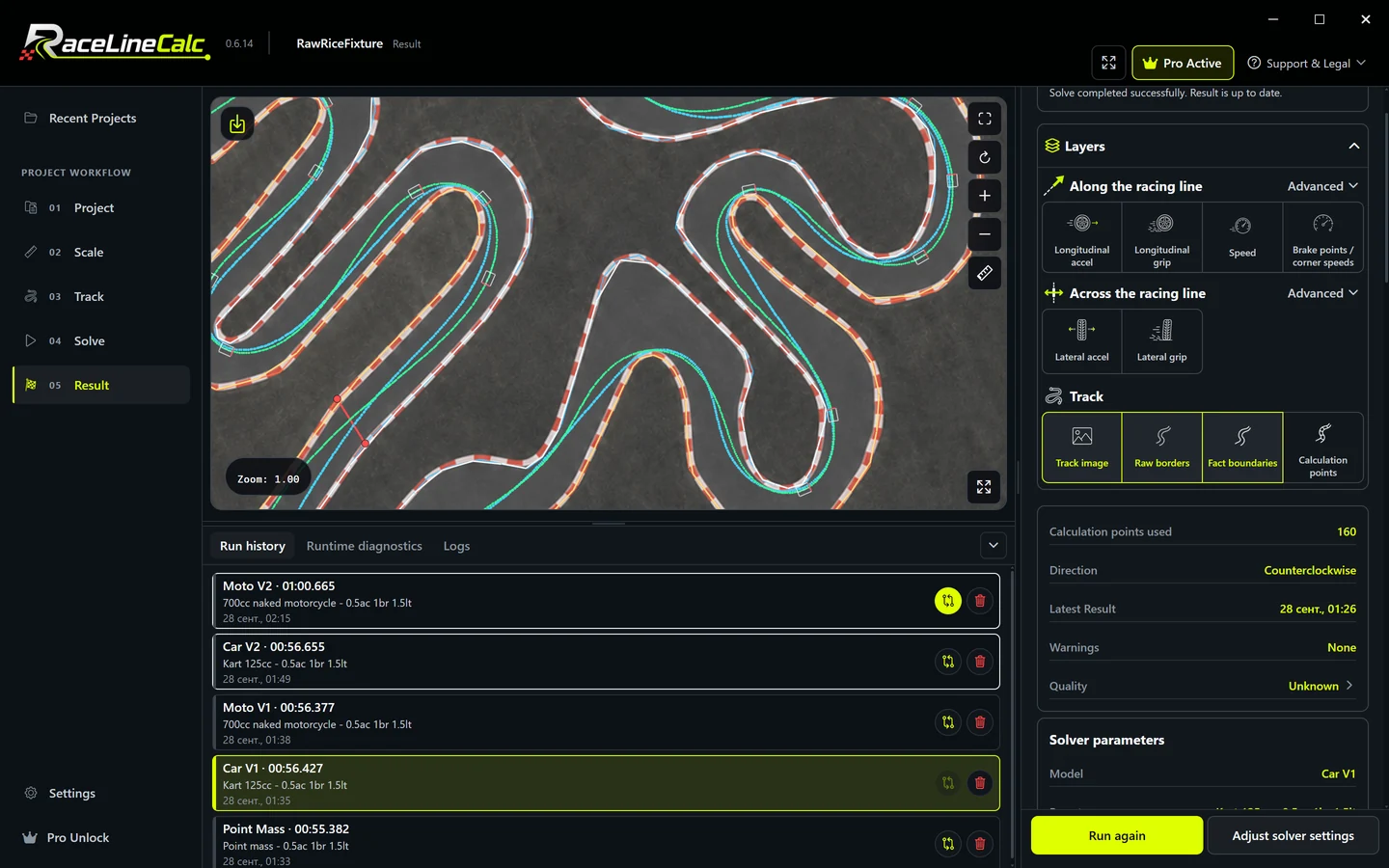
Racing line and lap time - RaceLineCalc
Racing line and lap time
Track editor - RaceLineCalc
Track editor
Point model setup - RaceLineCalc
Point model setup
Car model parameters - RaceLineCalc
Car model parameters
Acceleration overlays - RaceLineCalc
Acceleration overlays
Braking points and speed - RaceLineCalc
Braking points and speed
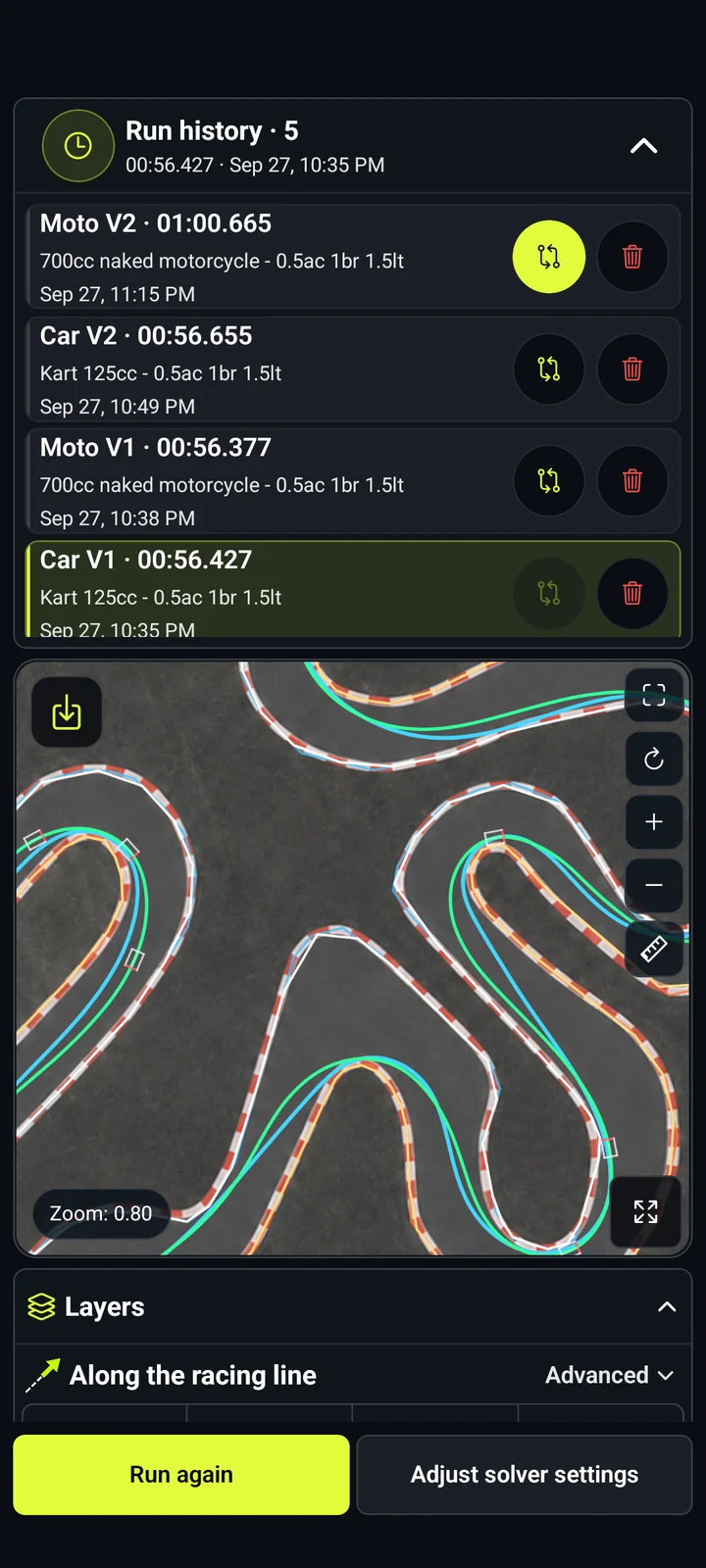
Run comparison - RaceLineCalc
Run comparison

What is RaceLineCalc?

RaceLineCalc turns your track image into a measurable 2D track and calculates its racing line.

Use it for karting circuits, permanent tracks, private layouts, or lesser-known venues when you have an image but no ready-made digital track model.


Workflow

How it works

  1. Import a track image, plan, sketch, or satellite view into a local project.
  2. Calibrate the image scale using a known distance.
  3. Trace or generate the left and right track boundaries and place the start line.
  4. Choose the driving direction, station count, physical model, and preset.
  5. Calculate the racing line locally on the device.
  6. Review lap time, speed, acceleration, and braking, then compare saved runs.

Store availability

RaceLineCalc is available on Google Play

The Android app is available now on Google Play by direct link or QR code. Availability on other platforms has not been announced.

RaceLineCalc Google Play QR code Google Play
App Store QR code will be added later App Store

If the QR code does not open, use the direct store link.

Racing calculations

What this racing calculator calculates

RaceLineCalc solves a minimum-time trajectory optimization problem on a calibrated flat 2D track. It combines track geometry with a selected point, car, or motorcycle model to calculate the resulting racing line, speed profile, braking points, acceleration, and model-calculated lap time.

Racing line from a track image

Import a track image, map, plan, sketch, or satellite view, calibrate the scale and boundaries, and turn the layout into a solvable 2D track model for racing line optimization.

Lap time and speed

The min-time solver searches for a time-efficient racing trajectory within the selected track geometry, vehicle model, grip, power, braking, and configured limits. Review the resulting racing line, speed profile, and model-calculated lap time.

Braking and acceleration

Compare point-based, car, and motorcycle trajectory models with mass, power, grip, braking, steering, acceleration, and lean-related limits.

Saved run comparison

Use the race track trajectory planner for karting circuits, indoor tracks, road courses, custom layouts, and local track studies, then compare compatible runs on the same geometry.

Point model

Start with a compact model that focuses on track geometry and a configurable acceleration envelope.

Car model

Explore presets and parameters for mass, power, braking, grip, dimensions, drivetrain, and aerodynamics.

Motorcycle model

Calculate a motorcycle racing line with bike-specific presets, acceleration limits, and lean-angle results.

Results you can inspect

Review the racing line, lap time, speed, longitudinal and lateral acceleration, braking points, run history, and a two-run comparison on the same track geometry.

Local project workflow

Core project editing and calculation run on the device without a mandatory account or project upload. Store purchases, advertising, and external links may require network access.

Model scope

  • RaceLineCalc calculates on a calibrated flat 2D track model.
  • Elevation, jumps, camber, changing surfaces, weather, traffic, and driver decisions remain outside the current model.
  • Source-image quality, scale calibration, boundary placement, model choice, and parameter values shape the calculated result.
  • Use the result together with real track knowledge, telemetry, and safe track testing.

FAQ

What kind of racing calculator is RaceLineCalc?

RaceLineCalc is a motorsport calculator for track geometry, racing lines, speed, acceleration, braking, and lap times. It does not calculate fuel consumption, pit strategy, race odds, or betting returns.

Does RaceLineCalc calculate the optimal racing line?

Yes. The min-time solver calculates a time-efficient racing trajectory for the track geometry, physical model, and parameters you provide. The current calculation uses a calibrated flat 2D track model.

Can I use RaceLineCalc for karting tracks?

Yes. Import indoor, outdoor, rental-kart, or custom circuit images, calibrate the scale, trace the track, and calculate the racing line.

Does RaceLineCalc support motorcycles?

Yes. The motorcycle model has bike-specific presets and parameters and calculates speed, acceleration, braking, and lean angle.

Does it calculate speed and lap time?

Yes. Completed runs include calculated lap time, speed, acceleration, and braking. The values come from the selected physical model and track geometry.

Does RaceLineCalc require an internet connection or account?

Core project editing and local calculation do not require an account or project upload. Store purchases, advertising, and external links may require internet access.

Which real-world effects are outside the 2D model?

The current flat 2D model covers track geometry and selected vehicle parameters. Elevation, jumps, camber, changing grip, surface condition, weather, traffic, and driver choices remain outside its scope.

RaceLineCalc is a local-first race trajectory optimization tool: a racing line calculator, track analyzer, lap time calculator, and minimum-time trajectory optimizer in one app. It supports image-based track analysis, optimal racing line calculation, speed-profile analysis, braking-point estimation, vehicle-model comparison, and minimum-lap-time studies on a calibrated flat 2D track.